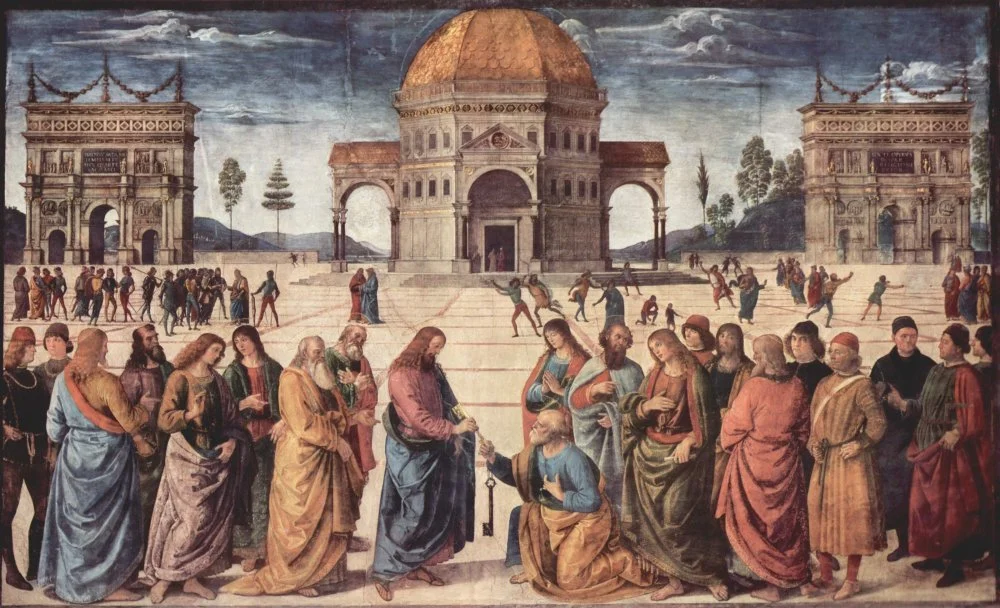
Linear perspective was one of the most significant and impactful technological inventions in the history of art. In Ontology of the Photographic Image, Andre Bazin calls it the “original sin of western painting.” Emerging at the onset of the Italian Renaissance, it provided a means of creating the illusion of space and therefore a claim to objective truth. 

Line, the technology on which linear perspective was based, is precise and specific. Thus, the system of lines that constitute linear perspective is mechanical in a way that seems to give the images greater authority; Perspectival images are not only realistic, but objectively so. 

However, with the invention of photography, there emerged another means of ‘objective’ representation. Like linear perspective, photography was a technology, with equal—if not greater—claims to objectivity. Something about the mechanical nature of the medium afforded it a special claim over truth. It is true that photography retains a unique, indexical relationship to the real. It is often said that photography is objective because of this. 

If photography and linear perspective both portray reality, there should be consistency between them. In many instances, however, this is not the case. It is these instances of discrepancy that this project takes as a starting point. 

System + counter system

This project treats photography and linear perspective as reciprocal systems of representation in order to question the supposed objectivity of each. It is not the goal to position photography as superior to linear perspective. Instead, I will argue that neither photography nor linear perspective can wholly encompass all spatial-visual experience. A comparison of these two technologies opens up our understanding of space. When photography does not confirm perspectival expectations, it reveals a new way of seeing the world and understanding our way of existing in space. 

Systematic parameters

Typical accounts of perspective argue that the central feature of perspective is the vanishing point. But the vanishing point is dependent on a horizon, which is in turn dependent on a ground, a picture plane and, ultimately, a viewer. Therefore, there are 5 parameters upon which linear perspective operates: viewer, picture plane, ground, horizon, and vanishing point. The presence of a viewer establishes a parallel, vertical picture plane and a perpendicular, horizontal ground plane. Where the ground stops denotes a horizon and somewhere on the horizon there is a vanishing point. All objects in the field of vision get oriented towards this point.

What happens to the overall system when one of these constituent elements are removed? For example, what if there was not a clear, singular horizon line? What if the relationship of the ground plane and the picture plane was not strictly perpendicular? Can linear perspective describe this space any longer? How would your understanding of the space be changed?

Note: I will primarily be talking about one-point linear perspective. Although, the successive logic I just outlined applies for two- and three-point perspective as well. Apart from the number of vanishing points, two- and three-point perspective have the same features: viewer, picture plane, ground, and horizon. 

In the following, I will work to criticize the normativity of linear perspective, using its own language of horizons, grounds, etc. to analyze photographs that elude perspectival explanation and, in doing so, point out the logical fallacies of the system. I will work systematically to critique linear perspective through one of these five parameters at a time. To do so, I will pair canonical renaissance paintings with contemporary photographs, working through a series of diagrams to explain the spatial logic of each. I will apply that same diagramatic language to both the painting and the photograph in order to show the logical discrepancy between the two. 


Picture Plane

Parallel to the viewer is the Picture Plane, corresponding to the surface of the image. Illusionistic painting was typically thought of as a window. This would make the Picture Plane like a piece of glass, “through which the viewer looks into the representation of reality that lies beyond.” But the Picture Plane is only the foremost plane to the viewer. There are an infinite number of imaginary vertical planes other than the Picture Plane. I will use the term ‘picture planes’ to describe all imaginary vertical planes, and the term ‘Picture Plane’ when referring to the surface of the image, or the framing device. 

Linear perspective contends that all imaginary vertical picture planes are strictly parallel to the Picture Plane. This is especially clear in a photo like the School of Athens by Raphael, in which, a series of flat, parallel walls, descending into space, make visible the notion of imaginary planes. 

  Here, the frame of the picture is a roman arch, instead of the usual rectangle. Think of the picture plane as this arch, the thing that encompasses the rest of the image. The image itself depicts 3 arches, each completely parallel to the Picture Plane. Think of these three walls as three imaginary vertical picture planes. Other objects in the painting, such as the figures, also exist on planes that are imaginary. Think of the first row of figures, those on the ground, as existing on one plane while the second row of figures, those on the raised platform, exist on another plane, at a slightly greater distance from the viewer. The parallel-ness and successiveness of these planes create the  illusion of recessive space. 

Sometimes, photographic representations can operate in a similar way to linear perspective paintings. For example, in a photograph like this one by Henri Cartier Bresson, the crumbling walls, like the walls with the Roman arches, illustrate the logic of receding picture planes. The walls, provide a spatial organizing device. Meanwhile, the boys, as they traverse the walls, recede into space according to the logic of successive, parallel, receding planes. 

But while this image confirms perspectival expectations, photography also has the ability to counter these expectations in its capacity to represent render reflective surfaces such as mirrors or glass. A reflection can show objects on a plane at an angle to the picture plane, or depict things outside the viewer’s narrow scope of vision. It can make objects appear next to each other when they are actually far apart. Therefore, the predominant logic of parallelism given by linear perspective is complicated by photography like Lee Friedlander’s, because planes are no longer purely parallel to each other, or the viewer. With the ability to render mirrors and reflections, photography enables an expanded, complexified version of planarity.